


News
Ankle Straps for Cable Kickbacks: Setup, Form and Glute Tips
Ankle Straps for Cable Kickbacks: Setup, Form and Glute Tips
Cable kickbacks are a go-to glute exercise in almost every gym, and ankle straps are what make them possible. Strap one around your ankle, clip it to a low pulley and kick back against the cable for constant tension on your glutes. Simple in theory, easy to get wrong in practice. This guide covers how to use ankle straps for cable kickbacks with good setup and form.
Why Use Ankle Straps for Kickbacks?
Without an ankle strap, there is no easy way to attach a cable to your leg. Holding a handle with your foot is awkward and unstable. A strap wraps securely around the ankle and clips to the cable, so the resistance moves with your leg through the whole range. That constant tension is what makes cable kickbacks so effective for targeting the glutes.
How to Attach the Strap
- Lower the pulley to the bottom position.
- Wrap the strap around your ankle, snug but comfortable.
- Clip the cable's carabiner to the strap's attachment ring.
- Step back from the machine until there is tension in the cable at the start position.
- Hold the frame with both hands for balance.
For a complete walkthrough, read how to attach ankle straps to a cable machine and how to wear ankle straps.
Cable Kickback Form
- Hinge slightly forward at the hips, keeping a neutral spine.
- Brace your core so your lower back stays still.
- Kick the working leg back and slightly up, leading with the heel.
- Squeeze the glute at the top for a second.
- Return slowly, keeping tension on the cable.
- Avoid arching your lower back to get the leg higher.
Our step-by-step guide on how to do cable kickbacks has variations and cues.
Pulley Height Options
- Lowest setting: the classic kickback with a strong squeeze at the top.
- Slightly raised: changes the resistance curve and can feel more natural for some lifters.
- Knee-height: for a more horizontal kickback.
Experiment to find what you feel most in your glutes.
Kickback Variations
- Straight-leg kickback: keeps the leg long for more glute and hamstring involvement.
- Bent-knee kickback: a 90-degree knee bend shifts more emphasis to the glutes.
- Diagonal kickback: kick back and slightly out to the side to involve the upper glutes.
- Pause kickbacks: hold the top for two to three seconds.
Programming Kickbacks
Kickbacks work best as an accessory after heavier compound lifts such as hip thrusts, squats or Romanian deadlifts. Try 3 or 4 sets of 12 to 20 reps per leg with controlled tempo. Read glute workout and how to do hip thrusts for a complete session.
Other Exercises With Ankle Straps
- Cable hip abduction: see cable hip abduction.
- Standing leg curls: read ankle straps for leg curls.
- Donkey kicks: see donkey kicks.
- Fire hydrants: see fire hydrant exercise.
- Cable pull-throughs: see cable pull-through.
Find more in ankle strap exercises and how to use ankle straps for cable glute exercises.
Choosing an Ankle Strap
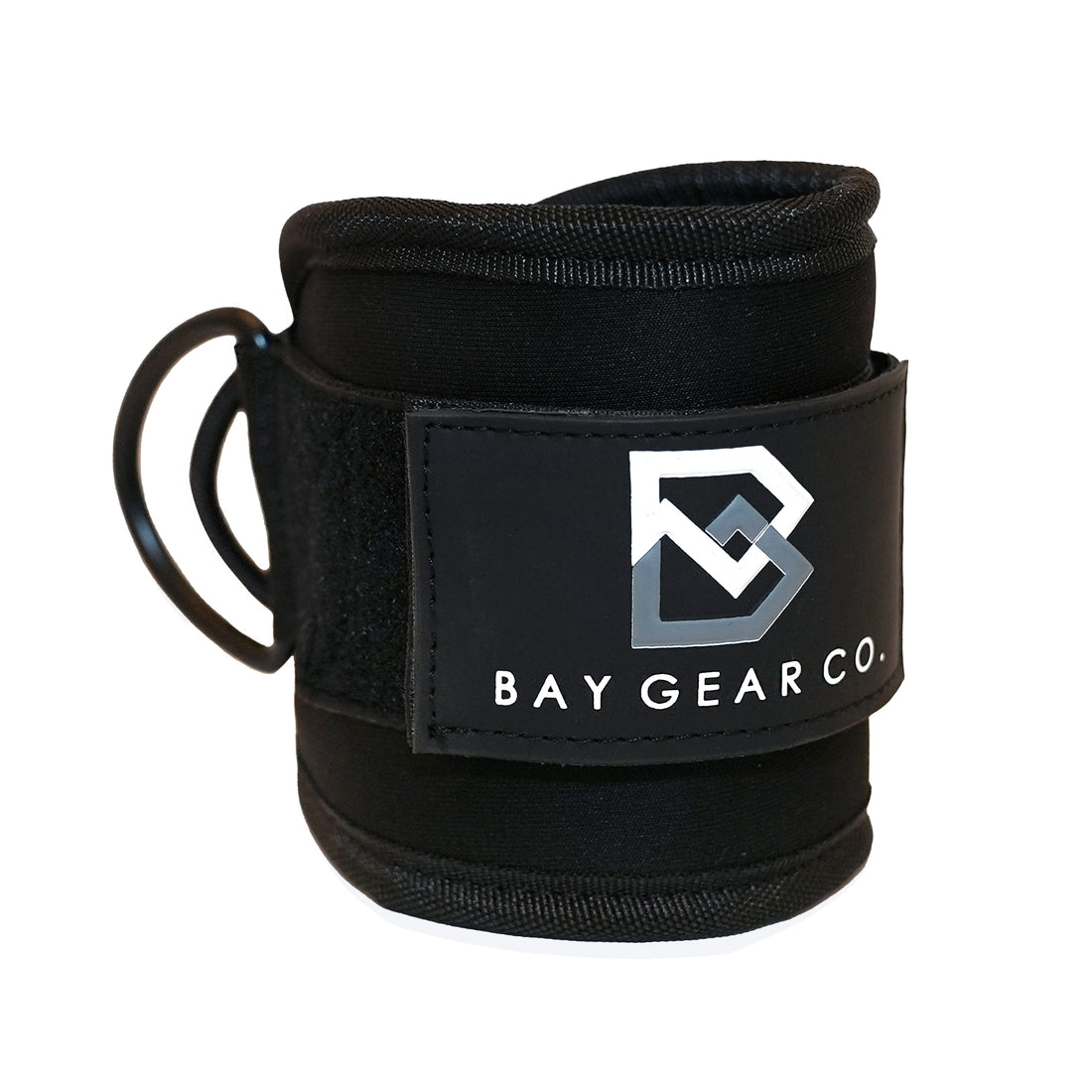
You want a strap that stays put, feels comfortable against the ankle and clips securely to the cable. The Bay Gear Co. ankle straps are $9.99 and come in colors like Black, Pink, Galaxy, OD Green and Tactical Hawaiian. See the full ankle straps collection, and read best ankle straps for cable machine.
One Strap or Two?
Most people only need one strap at a time for kickbacks, but a pair lets you switch legs faster or do exercises that use both ankles. At $9.99 each, many lifters keep two in their bag.
Mind-Muscle Connection on Kickbacks
Kickbacks are a small movement, so it is easy to let other muscles take over. Before each set, squeeze your glute on the working side while standing still so you know what the contraction should feel like. During the set, think about pushing your heel straight back rather than swinging your foot up. Use a weight you can hold at the top for a full second. If you feel it more in your lower back or hamstring than your glute, lower the weight and shorten the range slightly until the glute is clearly doing the work.
Common Mistakes
- Using too much weight: you end up swinging and arching your back.
- Rushing the reps: the slow return is where a lot of the tension happens.
- Strap too loose: it slides down onto your foot.
- Strap too tight: it becomes uncomfortable over a long set.
- Leaning on the machine: keep your torso stable and let the glute do the work.
Build a Glute Day Kit
- Knee sleeves, $59.99 for a 9.5", 7mm pair, for squats and lunges.
- A quick locking belt at $34.99 for heavy hip thrusts. Read lifting belt for hip thrusts.
- 24" lifting straps at $19.99 for heavy RDLs.
See gym accessories for women for more ideas.
Shipping and Returns
Our Bay Gear Co. store policy covers Ankle Straps for Cable Kickbacks: free shipping on orders over $49 and a 30-day return policy.
FAQ
Do I need ankle straps for cable kickbacks?
Yes. An ankle strap is the standard way to attach a cable to your leg.
Which pulley height is best for kickbacks?
The lowest setting is classic, but small adjustments can help you feel your glutes more.
How tight should an ankle strap be?
Snug enough that it does not slide, but comfortable for a full set.
How much are Bay Gear Co. ankle straps?
They are $9.99.